The short answer
Central Park was built between 1857 and 1876 on land New York State set aside in 1853. The naturalistic design, called the Greensward Plan, was created by Frederick Law Olmsted and Calvert Vaux, who won an 1858 design competition. The 843-acre park is almost entirely man-made, and its creation required removing Seneca Village, a community of mostly African American landowners. After decades of decline, the Central Park Conservancy was founded in 1980 and restored the park.
Central Park looks as though it has always been here, but every meadow, lake, and wooded hill was deliberately shaped by human hands. In the mid-1800s, a crowded, fast-growing New York had almost no public green space, and civic leaders argued the city needed a great park to rival those of London and Paris. What followed was one of the most ambitious public works projects of its century: 843 acres of swamp, rock, and farmland transformed into a designed landscape. This is the story our guides share on the road — how Central Park came to be, who built it, and what was lost along the way.
The push for a great public park
By the 1840s, New York was booming, but its residents had almost nowhere green to escape the crowded, noisy streets. Writers, merchants, and civic leaders began publicly campaigning for a large public park that could rival the grand grounds of London and Paris and give all New Yorkers, rich and poor, a shared place to breathe.
The campaign succeeded in 1853, when the New York State Legislature passed the Central Park Act, authorizing the city to acquire roughly 750 acres of land in the center of Manhattan through eminent domain. The chosen site, stretching from 59th to 106th Street, was rocky, swampy, and considered hard to develop — which made it relatively affordable. The land would later be extended north to 110th Street, reaching the park's familiar size of 843 acres.
The 1857 competition and the Greensward Plan
In 1857, the newly formed Central Park Commission held the country's first major landscape design competition, inviting plans for the new park. Thirty-three entries were submitted. On April 28, 1858, the commission chose the design called the Greensward Plan, created by Frederick Law Olmsted, the park's superintendent, and Calvert Vaux, an English-born architect.
Olmsted and Vaux imagined a naturalistic landscape that would feel wild and untouched even though every feature was planned and built. Their signature innovation was to sink the four required cross-streets below grade, hidden beneath the meadows and woodlands, so traffic could cross the park without breaking the illusion of open countryside. The Greensward Plan became the blueprint for nearly everything visitors see today, from the Mall to the Ramble.
Seneca Village: the community displaced
Before Central Park existed, part of the land was home to Seneca Village, founded in 1825 as one of New York City's first communities of free Black landowners. By the 1850s it had roughly 225 residents, three churches, schools, and cemeteries, and was later also home to Irish and German immigrants. Landownership among its Black residents was strikingly high for the era, making it a rare seat of stability and voting rights.
When the city acquired the parkland through eminent domain, Seneca Village and other settlements in the area were cleared. By the end of 1857, nearly 1,600 people across the site had been forced to leave and their homes torn down. Although landowners were compensated, many argued their property was undervalued. For decades the village was largely forgotten; today the Central Park Conservancy commemorates it near the park's West Side around 85th Street.
Building an entirely man-made landscape
Construction began in late August 1857, and the scale of the work was staggering. Thousands of laborers reshaped the rocky, swampy terrain, using gunpowder to blast bedrock, draining wetlands, and hauling in enormous quantities of soil to create the rolling meadows. Crews planted hundreds of thousands of trees and shrubs, so that almost nothing in the park grew there naturally — the landscape is essentially a vast designed garden.
The first areas opened to the public in the winter of 1858, when the Lake welcomed ice skaters, and the Ramble followed in 1859. Work continued for years as money and land allowed, and the park was considered substantially complete in 1876. The finished landscape combined sweeping pastoral lawns, formal promenades, a wooded wilderness, and grand architecture — a remarkable feat for a project built almost entirely by hand.
The landmarks and when they arrived
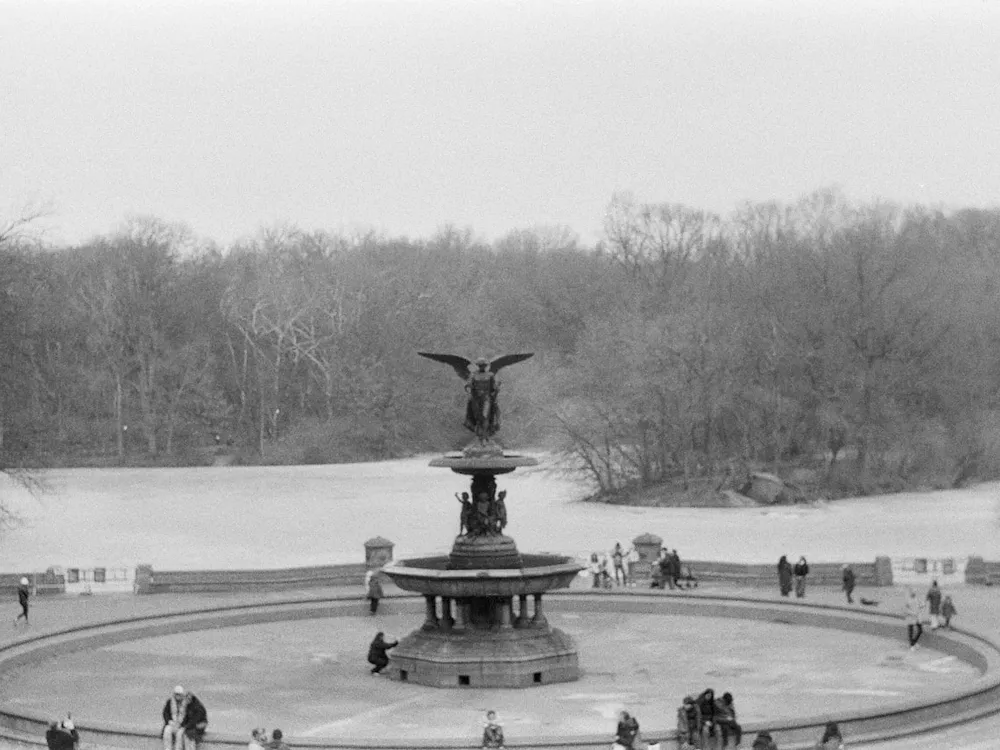
Many of Central Park's most beloved features were built during the original construction era and the decades that followed. The Mall, a formal promenade lined with American elms, was designed by Olmsted and Vaux as a grand walkway whose arching branches feel like a cathedral. Nearby, Bethesda Terrace and its fountain — crowned by Emma Stebbins's Angel of the Waters statue, unveiled in 1873 — became the architectural heart of the park.
Calvert Vaux, often with architect Jacob Wrey Mould, designed much of the park's romantic stonework, including Bow Bridge (1862), the elegant cast-iron span over the Lake, and Belvedere Castle (1869), a fairy-tale lookout above the Ramble. A century later, in 1985, the park dedicated Strawberry Fields, a quiet memorial to John Lennon near West 72nd Street, anchored by the Imagine mosaic.
- The Mall — a formal elm-lined promenade central to the original Greensward Plan.
- Bethesda Terrace and Fountain — the park's grand centerpiece, with the Angel of the Waters statue unveiled in 1873.
- Bow Bridge — a graceful cast-iron bridge over the Lake, built in 1862 by Vaux and Jacob Wrey Mould.
- Belvedere Castle — a stone lookout completed in 1869, offering views over the Ramble and Turtle Pond.
- The Ramble — a deliberately wild 36-acre woodland, opened to the public in 1859.
- Strawberry Fields — a memorial to John Lennon dedicated in 1985, with the Imagine mosaic.
Decline and the 1980 rebirth
By the mid-20th century, Central Park had fallen on hard times. Through the 1960s and 1970s, shrinking city budgets and deferred maintenance left lawns worn to dust, monuments covered in graffiti, and benches and bridges crumbling. The park gained a reputation for neglect and disorder, and many New Yorkers came to see it as unsafe.
The turning point came in 1980, when concerned citizens founded the Central Park Conservancy, a nonprofit partner to the city dedicated to restoring and caring for the park. Over the following decades the Conservancy rebuilt landscapes, restored fountains and bridges, and replanted vast areas, raising hundreds of millions of dollars in private funds. In 1998 it formally took over day-to-day management of the park. The lush, well-kept Central Park visitors enjoy today is the result of that long restoration.
Central Park at a glance: a timeline
From the first land purchase to the modern restoration, a handful of milestones shaped the park New Yorkers know today.
| Year | Milestone |
|---|---|
| 1853 | New York State passes the Central Park Act, authorizing the land purchase. |
| 1857 | Design competition held; construction begins in late August. |
| 1857–1858 | Seneca Village and other settlements are cleared by eminent domain. |
| 1858 | Olmsted and Vaux win with the Greensward Plan; the Lake opens to skaters. |
| 1862 | Bow Bridge is built over the Lake. |
| 1869 | Belvedere Castle is completed above the Ramble. |
| 1873 | Bethesda Fountain's Angel of the Waters statue is unveiled. |
| 1876 | The park is considered substantially complete. |
| 1980 | The Central Park Conservancy is founded to restore the park. |
| 1985 | Strawberry Fields is dedicated to John Lennon. |
Frequently asked questions
When was Central Park built?
Central Park was built largely between 1857 and 1876. New York State set the land aside in 1853, construction began in late August 1857, the first areas opened to the public in the winter of 1858, and the park was considered substantially complete in 1876.
Who designed Central Park?
Central Park was designed by Frederick Law Olmsted and Calvert Vaux, whose Greensward Plan won the design competition on April 28, 1858. Olmsted served as the park's superintendent and Vaux was an English-born architect; together they shaped its naturalistic landscape.
What was Seneca Village?
Seneca Village was a community founded in 1825 on land that became Central Park. Home to roughly 225 residents, it was one of New York City's first settlements of free Black landowners, with churches, schools, and cemeteries. Its residents were displaced by eminent domain in 1857 to build the park.
Is Central Park natural or man-made?
Central Park is almost entirely man-made. Its 843 acres of meadows, lakes, and woodlands were deliberately designed and built in the 1850s and 1860s, requiring workers to blast bedrock, drain swamps, move vast amounts of soil, and plant hundreds of thousands of trees and shrubs.
How big is Central Park?
Central Park covers 843 acres in the middle of Manhattan, running from 59th Street to 110th Street and from Fifth Avenue to Central Park West. The original 1853 site was about 750 acres, later extended north to reach its present size.
Why did Central Park decline and how was it saved?
Through the 1960s and 1970s, tight city budgets and deferred maintenance left Central Park worn, vandalized, and unsafe. It was rescued by the Central Park Conservancy, a nonprofit founded in 1980 that restored the landscapes and, in 1998, took over the park's day-to-day management.
See it from the seat
The best way to know Central Park is to ride through it. Pedicab, bike, e-scooter, or on foot — book in under a minute.